
Inside women’s football’s difficult rise in Syria: ‘A joy that everyone in the country needed’
The Guardian
In December 2024, Syria’s under-18 women’s football team boarded a last-minute bus at midnight from Aqaba, bound for Damascus. The players had been in Jordan preparing for their final match of the WAFF women’s championship, where a win against Saudi Arabia would have kept their hopes of winning the title alive. Syria pulled out amid fears that the border would close.
Back home, a war that had been largely frozen for four years was suddenly moving at pace. Rebel forces had swept out of the northwest, taking Aleppo and were pushing south towards the capital, 350km away, threatening to topple the now-former president, Bashar al-Assad. Players from the provinces around Damascus made their way home. But those from Hasakah, in the country’s far north-east, spent the next three days stranded at Damascus airport, as airline staff fled and planes sat idle on the tarmac, until a bus was finally able to take them home.
Scared, exhausted and running on adrenaline, the team had lived through another episode of disruption; but in truth they had rarely known stability. For Syrian women’s footballers, navigating uncertainty had been part of the game long before the country’s political upheaval reached its latest turning point. “My generation was burned away and completely lost,” said Noor Jumaa, a former national team goalkeeper. “It was like everything that was being built just disappeared.”
After 14 years of war, Syria has much to rebuild. Women’s football is among the institutions trying to recover from a conflict that erased an entire generation of players, interrupted the development of the game itself and left its infrastructure struggling. Yet, in recent years, Syria’s youth teams have emerged as one of the country’s more unexpected sporting success stories, winning regional titles and producing players who are beginning to make their mark abroad.
Syria’s women’s national team played their first international match in 2005. By 2011, plans were under way for an 11-a-side women’s league. Then the uprising began, and all plans were abandoned. For the next six years, women’s football in Syria effectively stopped. There were no international fixtures at any level, only occasional futsal tournaments. More than six million people eventually fled Syria, including hundreds involved in the sport, leaving an already small pool of players scattered across the world.
Men’s football, by contrast, continued. The national team played matches abroad after Syria was barred from hosting fixtures in 2011 on security grounds. The Assad regime used its successes to project an image of normality, even welcoming the squad to his palace after their 2012 WAFF Championship victory. Fifa, despite its rules against political interference, stayed silent.
Girls growing up in those years had no women’s team to watch. “I was watching a match of Syria’s men’s national team, and I was really upset. I would say, ‘God, if only they’d make a national team for girls,’” recalled Raneem Abo Lateef, a 21-year-old goalkeeper for Syria. The opportunity came unexpectedly after her family moved houses, and a girl next door told Abo Lateef that a relative was starting a girls’ club. “Girls’ football? Wow,” she said. “It was like dreams coming true.”
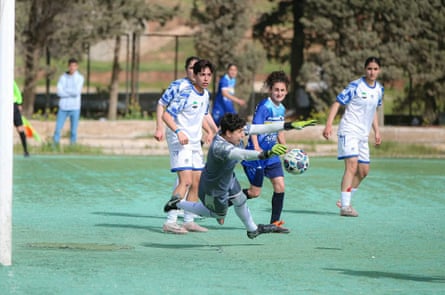 Raneem Abo Lateef makes a save in the Syrian women’s league Photograph: Ibrahim Janoudi / SFA
Similarly, international teammate Julnar Mustafa spent hours playing with boys in her neighbourhood in Hasakah. Born in 2008, so too young to remember the beginning of the uprising, she filmed herself dribbling and performing tricks on her phone, uploading the videos to Facebook. A regional coach came across them and invited Mustafa to join his team.
But finding an opportunity to play was only part of the challenge. “In our society, especially in the north, in Hasakah, sport is completely off-limits for girls,” Mustafa told the Guardian. “Not football, not anything”.
While a new generation of girls were finding their way into football, the national team was attempting to return to international competition. In April 2017, Syria entered the Asian Cup qualifiers in Vietnam, assembling a squad after six years without any activity. The federation announced tryouts on Facebook, and players were given about a month of preparation. Syria went on to lose every match, including a 14-0 defeat by Myanmar. “Honestly, it was one of the worst teams in Syria’s history,” said Jumaa, who was part of that squad. “We lost by terrifying scores.”
Maha Al-Katreb, also in the squad at the time, remembers the criticism that followed. Players were ridiculed despite having had little preparation. At the tournament, she saw opponents arrive with larger coaching staffs and younger players training alongside their senior teams. The gap between Syria and their regional competitors was difficult to ignore.
With injuries ending her career early, Al-Katreb fell into coaching by chance and turned towards building a programme that could develop the next generation. She later joined the Syrian Football Association (SFA), taking on administrative and coaching responsibilities.
A six-team women’s senior league was established in 2019, followed by the development of youth national teams. This year the country held an inaugural edition of its youth league. Al-Katreb developed Syria’s first women’s football strategy, submitted to Fifa, that set out a longer-term plan for expanding participation and creating a pathway into the national teams. “You have to start building from the bottom if you want to see results after these 10 years,” Al-Katreb said. “So that we don’t burn one generation after another.”
In 2022, women accounted for only 1,000 of Syria’s 25,000 registered footballers. The women’s football strategy, seen by the Guardian, aimed to increase female participation by 150% over four years, including through 33 school training centres across 11 provinces, with capacity for 1,650 girls by 2026.
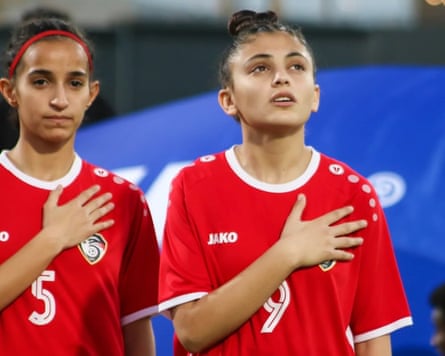 Julnar Mustafa stands for the national anthem. Photograph: Syria Football Association
The government has also outlined plans to rehabilitate the country’s sporting infrastructure. Rami Alsubea, an adviser at the Ministry of Sport and Youth, said in a statement that 48 sports facilities had been rehabilitated in 2025, with plans to rehabilitate about 150 more and build about 20 new ones by 2028. Restoring infrastructure is in part to meet hosting criteria set by Fifa and the Asian Football Confederation (AFC).
Al-Katreb left the federation more than a year ago. Jumaa is now part of a two-woman team leading its women’s football department, appointed after the arrival of the federation’s current president, Feras al-Teet. Several players have criticized the federation’s leadership and the pace of progress. The Guardian reached out to Al-Teet for comment. He declined.
Among the players who have been vocal about the shortcomings is 26-year-old Rona Aizouk, one of the most experienced members of the current generation. Named after Brazilian footballer Ronaldinho, she made history in 2023 when she became the first Syrian-born woman to sign a professional contract, joining Saudi side Najmat Jeddah. Her performances in Syria had attracted the club’s attention, but securing the move proved difficult. Visa refusals and paperwork complications delayed her arrival until two days before the season began. Her time in Saudi Arabia lasted only a few months, and she was unable to extend her stay.
“Honestly, I went there not wanting to come back,” said Aizouk. “There’s no comparison. Everything is better, the treatment, the training, the facilities. It’s just different.
“The most important thing is the players’ comfort. Here in Syria, we have to endure psychological pressure and torment. As a player, I have to fight the world just to achieve even a little bit of success.”
After returning to Damascus to complete her studies, Aizouk quickly received interest from multiple clubs in Jordan, where she now plays. For her, being in situ abroad is about more than personal progression. “I want to be a message that I, who came out of hard circumstances and out of a war, still managed to succeed.”
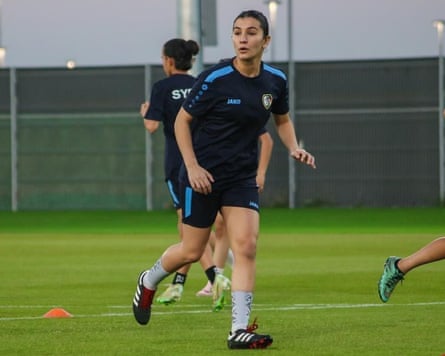 Rona Azouk in training with Syria. Photograph: Syria Football Association
Aizouk’s exposure to regional excellence has shown her that Syria is still many years behind. At the forefront is financial restriction that has left the sport bare-boned. International sanctions and banking restrictions imposed on Syria left millions of dollars in development funding from Fifa inaccessible to the SFA, preventing it from fully benefiting from programmes such as Fifa Forward.
Although broad economic sanctions have since been lifted, an estimated $11.5m in funds remains inaccessible to the federation. Both the SFA and Fifa insist they are working to establish a mechanism through which the money can be transferred. For now, the support has been seen in training equipment.
The financial strain is felt directly by players as both the national team and regional league are operated by the SFA. Clubs frequently go months without paying wages, and when payments do arrive, players say they can fall short of the amounts agreed. International call-ups offer little relief: during national team duty, including training camps, players receive a daily allowance of $20, capped at $200 for the length of their stay, regardless of how long it is. Some say the costs of travelling and playing can exceed what they receive.
Several clubs have folded since the domestic league’s launch in 2019, citing financial difficulties and the continued disruption caused by the war and ongoing conflicts. Those that remain often struggle to provide even basic resources.
Al-Hilal, now renamed Qamishlo Sport, have become one of the country’s most successful women’s sides, currently reigning as senior and youth league champions. But their achievements have not translated into financial security, according to head coach, Daleel Khalid. “There’s an absence of adequate support from all sides and the parties responsible for Syrian women’s sports, whether in terms of training camps and preparation, or the capabilities and infrastructure needed to develop the game,” he said.
The club’s campaign at the 2026 WAFF Women’s Clubs Championship was a big test. The tournament brought together league champions from six regional competitions. Despite having only a short training camp at home, Al-Hilal reached the final against Saudi champions Al-Nassr. Abo Lateef and Mustafa were among those who represented them, and their performances offered a reminder that Syrian teams can compete with the region’s best, even when their opponents have considerably greater resources.
There was also individual recognition. Al-Hilal’s Mai Al-Jani was named the tournament’s best player after a series of standout performances, an achievement she was quick to share with those around her. “The award I won is a source of pride for me, for the club and for the players. I see it as a team award,” she said. “It belongs to the staff, the players, and every Syrian girl living through these difficult circumstances.”
Born in 2006 in a small village in Homs province, Al-Jani has emerged as one of Syria’s promising attacking talents. She won the league’s Golden Boot in the 2024-25 season and has continued to impress for both club and country. She was also named the best player at the 2023 WAFF under-17 championship, when Syria won their first international title in women’s football. Al-Katreb, who was an assistant coach, saw the victory as evidence of what the country could build with the right support.
The WAFF under-17 triumph was repeated at the 2026 edition with a completely different squad. “It was joy that everyone in the country needed,” said Jumaa. “We were completely outnumbered in technical and admin staff, with only nine of us managing everything. Other teams had double the number of staff, with gameplay technology we can’t get our hands on.”
For Abo Lateef, the greatest risk is allowing another generation of players to lose the chance to compete. The senior women’s national team, for instance, has not played in over two years, with no reason given to players. “We need competition, regardless of the level,” said Abo Lateef. “I’m afraid a day will come when I’m made to sit at home, as was the case with the ones before us. A friendly fixture is a good start. Anything.”
Aizouk’s message to those responsible for the future of the women’s game was more direct. “Save Syrian football,” she said. “Save the generations. Save us.”